10 Cyberbullying Statistics
"A lie can travel halfway around the world while the truth is putting on its shoes." -Mark Twain
According to The Cyberbullying Research Center, cyberbullying is "when someone repeatedly and intentionally harasses, mistreats, or makes fun of another person online or while using cell phones or other electronic devices.” Before jumping into ways to prevent and address cyberbullying, I thought it would be useful to share some statistics as a way of providing some context and perspective around the issue. Below are 10 cyberbullying statistics to help you better understand the scope of the issue:
1. 34% of students between the ages of 12 and 17 have been the victims of cyberbullying in their lifetime. (Source: Cyberbullying Research Center)
2. 12% of students between the ages of 12 and 17 admitted that they had cyberbullied others at some point in their lifetime. (Source: Cyberbullying Research Center)
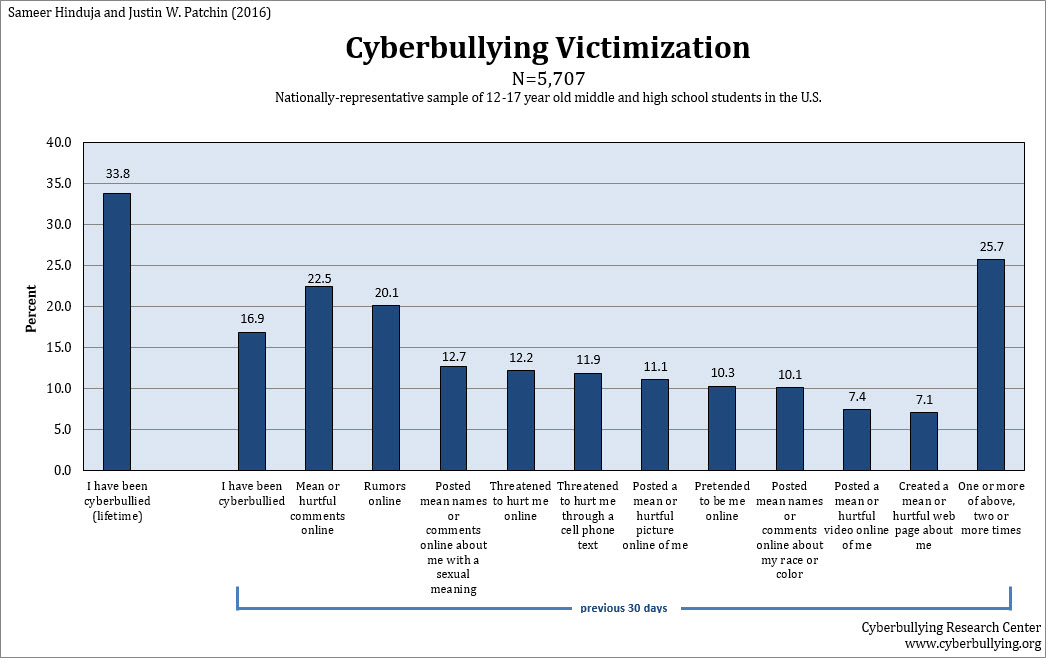
3. 80% of students who have been cyberbullied said mean comments were posted about them online, while 70% of students who have been cyberbullied said someone spread rumors about them online. (Source: Cyberbullying Research Center)

4. 64% of students who have experienced cyberbullying said that it significantly affected their ability to learn and to feel safe at school. (Source: Cyberbullying Research Center)
5. The most commonly reported cyberbullying behaviors include spreading rumors online (60%), posting mean comments online (58%), and threatening to hurt someone online (54%). (Source: Cyberbullying Research Center)
6. Girls (36.3%) are slightly more likely to experience cyberbullying than boys (30.7%). (Source: Cyberbullying Research Center)
7. Boys (13.3%) are slightly more likely to have cyberbullied others than girls (10.7%). (Source: Cyberbullying Research Center)

8. 15% of students age 12 to 17 have been targeted online as well as at school. (Source: Cyberbullying Research Center)

9. There are no differences based on race when it comes to experiencing cyberbullying. (Source: Cyberbullying Research Center)
For me, statistic #6 - 64% of students who have experienced cyberbullying said that it significantly affected their ability to learn and to feel safe at school - is very concerning given that it's extremely important to me that our students feel safe at school and are able to learn. The statistic motivates me to learn more about what I, along with teachers, parents, and students, can do to prevent and address cyberbullying, which I will write about in my next post.
If any of the statistics above are particularly striking to you, please share your thoughts about them in the comments section below and I will try to incorporate a response into my next post.
Looking forward to discussing action steps that we can take to deal with cyberbullying!
If any of the statistics above are particularly striking to you, please share your thoughts about them in the comments section below and I will try to incorporate a response into my next post.
Looking forward to discussing action steps that we can take to deal with cyberbullying!

I agree about #6 especially since safety in the school has been correlated to growth in student achievement.
ReplyDeleteYes - good point to make the link between feeling safe and student achievement.
Delete#7 intrigued me because I would have thought it was the other way around, with girls having a higher percentage of being cyber bullied. I feel like girls might have more of drama issues with friends, so maybe they didn't consider it to be "cyber bullying". But, I wonder if it actually is. Like you said, #6 is very concerning. But while it's concerning, I think it is an obvious statistic. Students who get bullied, in person or online, are less likely to feel safe. Feeling safe is essential to learning.
ReplyDeleteGreat point. Even the researchers suggest that the difference is minimal and could be the other way around in a subsequent survey.
DeleteThis comment has been removed by the author.
ReplyDelete